Projects

Previous Research (Online Slides)

Fiber–matrix FEM–neural operator coupling workflow with six stress-component operators shared across 100 fibers, interface force assembly, and IQN-ILS acceleration.
Fiber–Matrix FEM–NO coupling workflow

GPU-accelerated Hybrid Finite Element–Neural Operator Solver Ongoing

Develops a hybrid FEM–neural operator solver for solid mechanics using non-overlapping domain decomposition. Trains Transolver models in JAX on GPU-accelerated JAX-FEM simulation data to predict subdomain stresses from interface displacements. During coupling, the FEM solver receives interface reaction forces computed from the predicted stresses and returns updated interface displacements to the neural operators for the next iteration.

Research details
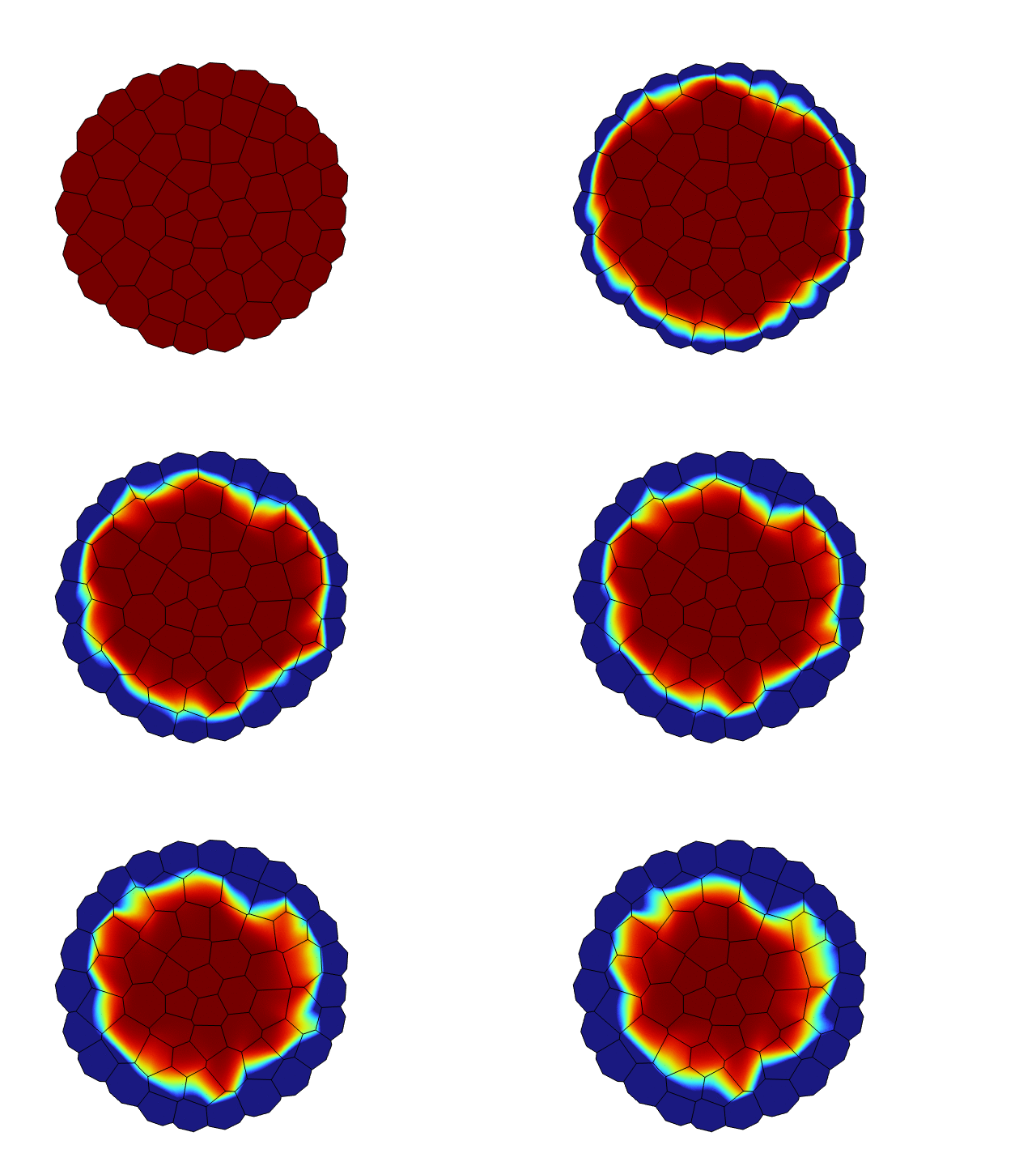
Lithium concentration evolution in the COMSOL simulation dataset.
Concentration evolution · COMSOL

ConvLSTM Prediction of Concentration and Stress Fields in Battery Materials

Trains con­di­tional ConvLSTM mod­els in PyTorch to pre­dict future sequences of con­cen­tra­tion and stress fields in poly­crys­talline bat­tery mate­ri­als. Separate mod­els for each field use past field images, grain-orientation maps, and C-rate inputs, with MATLAB–COMSOL sim­u­la­tion data and a com­bined MSE and SSIM loss.

Repository
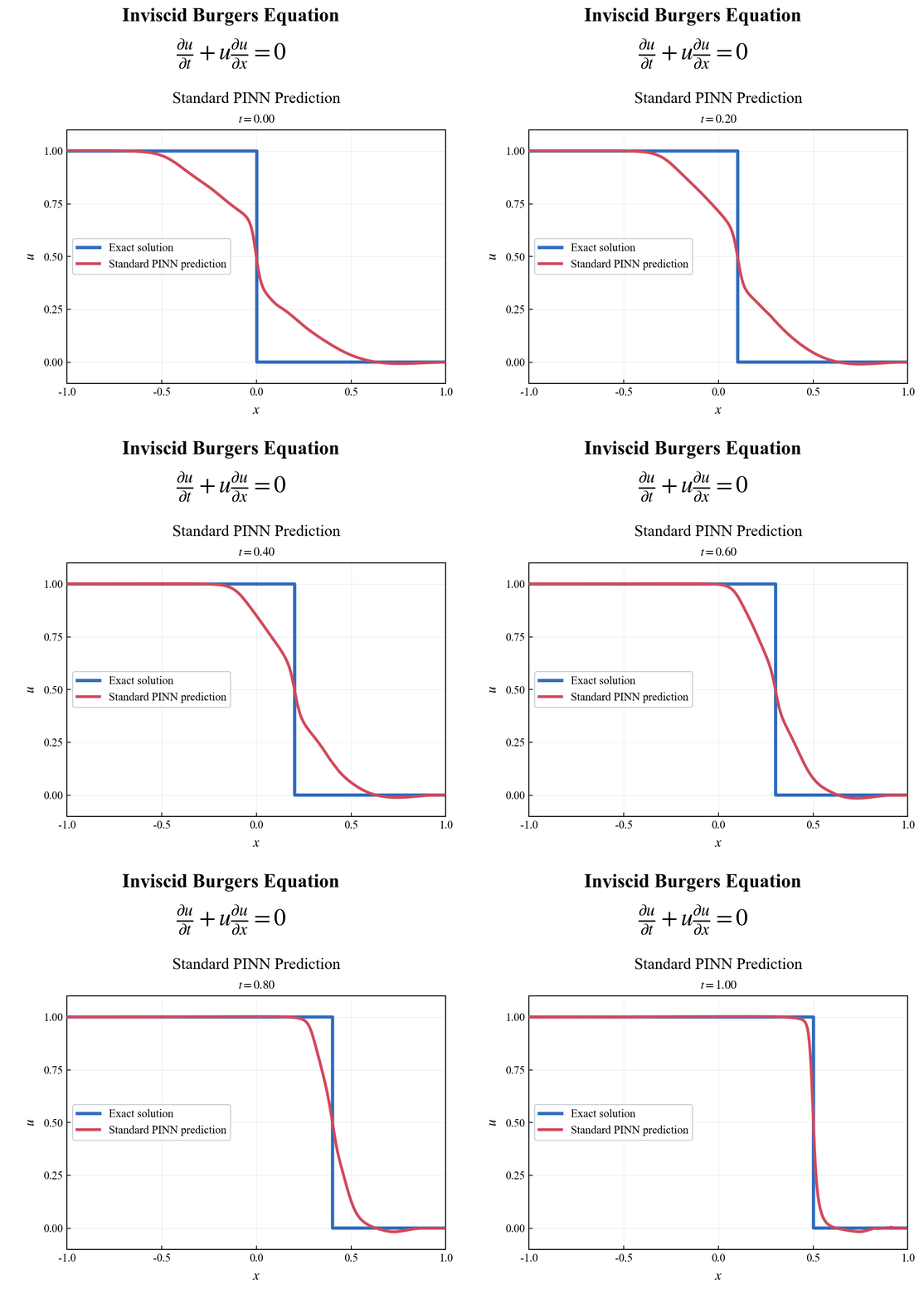
Standard PINN prediction compared with the analytical Burgers shock solution.
Standard PINN prediction

PINNs for Shock Capturing in the Burgers Equation

Trains PINNs in PyTorch for the one-dimensional Burgers shock problem using PDE-residual, initial-condition, and boundary-condition losses. Compares models with and without a fixed artificial-viscosity coefficient against the analytical inviscid solution.

Repository
Mechanics dataset preparation, LoRA fine-tuning, and model release workflow.
Fine-tuning and release workflow

Domain-Specific LLM Fine-Tuning for Mechanics of Materials

Adapts Qwen2.5-7B for ques­tion answer­ing and con­cept expla­na­tion in mechan­ics of mate­ri­als through LoRA fine-tuning on Google Colab. Uses curated instruction–response exam­ples from text­books and tech­ni­cal lit­er­a­ture, with datasets and fine-tuned mod­els released on Hugging Face.

Hugging Face